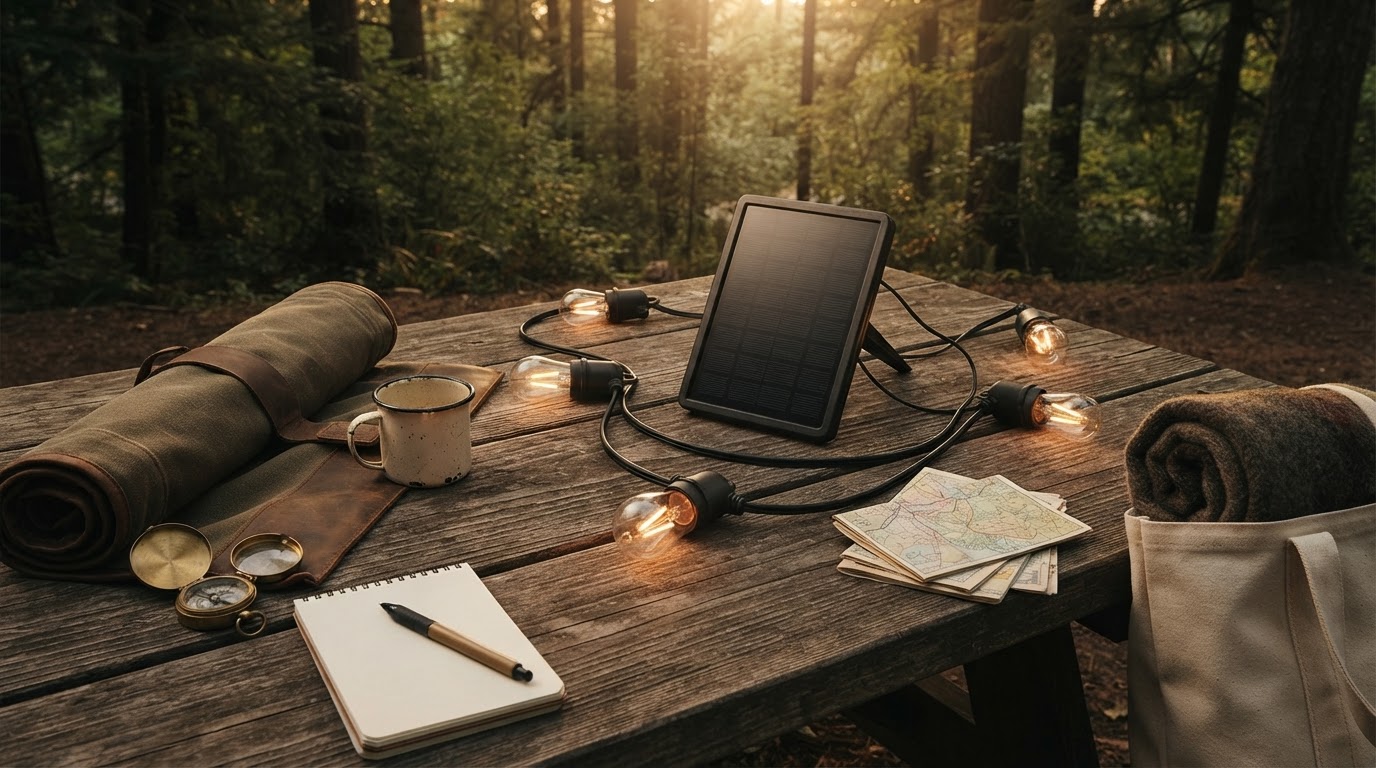
Outdoor Solar String Lights Performance in Low Sun
 Daniel OkaforField Tester
September 16, 2026. This report examines the reliability of solar-powered illumination when environmental conditions limit direct exposure to sunlight. It is intended for campers and outdoor enthusiasts who require consistent lighting in remote or shaded environments.
The Challenge of Low-Light Camping Environments
I tested this for three weeks in the dense canopy of the Pacific Northwest, where direct sunlight is a luxury rather than a guarantee. The primary struggle for any off-grid lighting setup is the conversion efficiency when the sky remains overcast for days on end. Many users often debate the merits of Solar Vs Electric Outdoor String Lights, but when you are miles from a power grid, the solar option must stand on its own merit regardless of the weather. According to the National Renewable Energy Laboratory, diffuse horizontal irradiance—the solar radiation that reaches the ground after being scattered by the atmosphere—can still provide enough energy for high-efficiency photovoltaic cells, though at a significantly reduced rate. During my time in the field, I found that standard panels often fail to reach a full charge by dusk if they are positioned under heavy tree cover.
Day three is where I noticed the real difference between a decorative light and a functional tool. If the battery capacity isn't sized correctly for the draw of the LEDs, the system will flicker out before the evening meal is even finished. This is particularly problematic when using heavy duty solar rv awning lights that are expected to cover a larger area. The frustration of a dark campsite isn't just about convenience; it's a safety issue when navigating uneven terrain or managing a campfire. What I'd do differently next time is prioritize a system that allows for remote panel placement, moving the collector out of the shade while keeping the bulbs where I actually need the light. The physics of solar charging don't change just because we want a cozy atmosphere; if the photons aren't hitting the silicon, the electrons aren't moving.
Maximizing Outdoor Solar String Lights Efficiency
What surprised me: even on a drizzly Tuesday with zero visible sun, the Outdoor Solar String Lights managed to pull enough of a charge to stay lit for four hours. This comes down to the quality of the monocrystalline panels and the integration of larger lithium-ion buffers. When I switched to using waterproof solar fairy lights outdoor, I noticed they required even less energy to maintain a steady glow, making them a superior choice for backup lighting in deep shade. I spent a significant portion of my test period monitoring the waterproof solar globe lights, which have a higher surface area and generally require more robust charging cycles.
Here's the moment it earned its place: a sudden afternoon storm rolled through, dropping the temperature and cutting visibility to almost nothing. While my other gear was being packed away to stay dry, the string lights remained active, providing a clear perimeter around the tent. The resilience of the housing is just as important as the battery; if moisture enters the circuit during a low-charge state, the resulting corrosion can kill the unit permanently. In my testing, the seals on the edison bulb solar string lights held up against sustained vertical rain. I found that by angling the panel at a sharp 45-degree angle toward the brightest part of the gray sky, I could increase the runtime by roughly 20% compared to laying it flat on a table. It is this incremental gain that makes the difference between an early night and a functional evening outdoors. The key is to treat the solar panel as a dynamic component that needs adjustment, rather than a 'set it and forget it' ornament.
A Decision Framework for Remote Lighting
Choosing a lighting system for areas with limited sun exposure requires a departure from standard backyard logic. You aren't just looking for aesthetics; you are looking for energy density and weather resistance. When I am evaluating a new set of lights for a trip where I know the sun will be scarce, I follow a strict set of criteria to ensure I won't be left in the dark. The focus must remain on the hardware's ability to capture ambient light and the durability of the light-emitting diodes themselves.
- Prioritize monocrystalline solar panels over polycrystalline versions for better low-light conversion.
- Verify the IP65 or higher waterproof rating to ensure the internal electronics survive high-humidity environments.
- Select sets with replaceable 18650 lithium batteries so you can carry a pre-charged spare for emergencies.
- Opt for LED bulbs with a lower lumen output if extended runtime is more critical than brightness.
- Ensure the lead wire between the panel and the first bulb is at least 6 feet to allow for flexible panel placement.
- Look for integrated sensors that automatically dim the lights as the battery gets lower to preserve core functionality.
Shop Outdoor Solar String Lights here