Outdoor Solar String Lights for Shaded Campsites
 Daniel OkaforField Tester
October 1, 2026. This field report evaluates how to maintain reliable illumination with Outdoor Solar String Lights when campsite canopy cover limits direct sun exposure. It is written for backpackers and car campers who prioritize consistent light over fluctuating weather conditions.
The Reality of Charging Under the Canopy
I tested this for a four-day stretch in the damp, heavily forested sections of the Pacific Northwest where the sun rarely breaks through the Douglas firs. The primary challenge with traditional solar setups in these environments is the lack of direct UV rays hitting the photovoltaic cells. According to REI Co-op, high-quality solar units like the 44-foot string models provide up to 200 lumens, but that output is entirely dependent on the battery's state of charge. When you are parked under a dense thicket, a standard fixed-panel light often fails by the second night. During my trip, day three is where I noticed the standard solar-only units in our group started to flicker out by 9:00 PM. The canopy was simply too thick for a passive charge. This is a common point of failure for campers who rely solely on the sun without a secondary power plan. You need to understand the distinction between 'ambient light' and 'direct solar radiation'; the former will rarely top off a high-capacity battery enough to power 20 or more LEDs for an entire evening. If you are planning to [hang outdoor string lights](/blog/how-to-hang-outdoor-string-lights) in a permanent camp spot that doesn't see at least six hours of clear sky, the physics of solar charging becomes your biggest hurdle.
Solving the Sun Gap with Hybrid Features
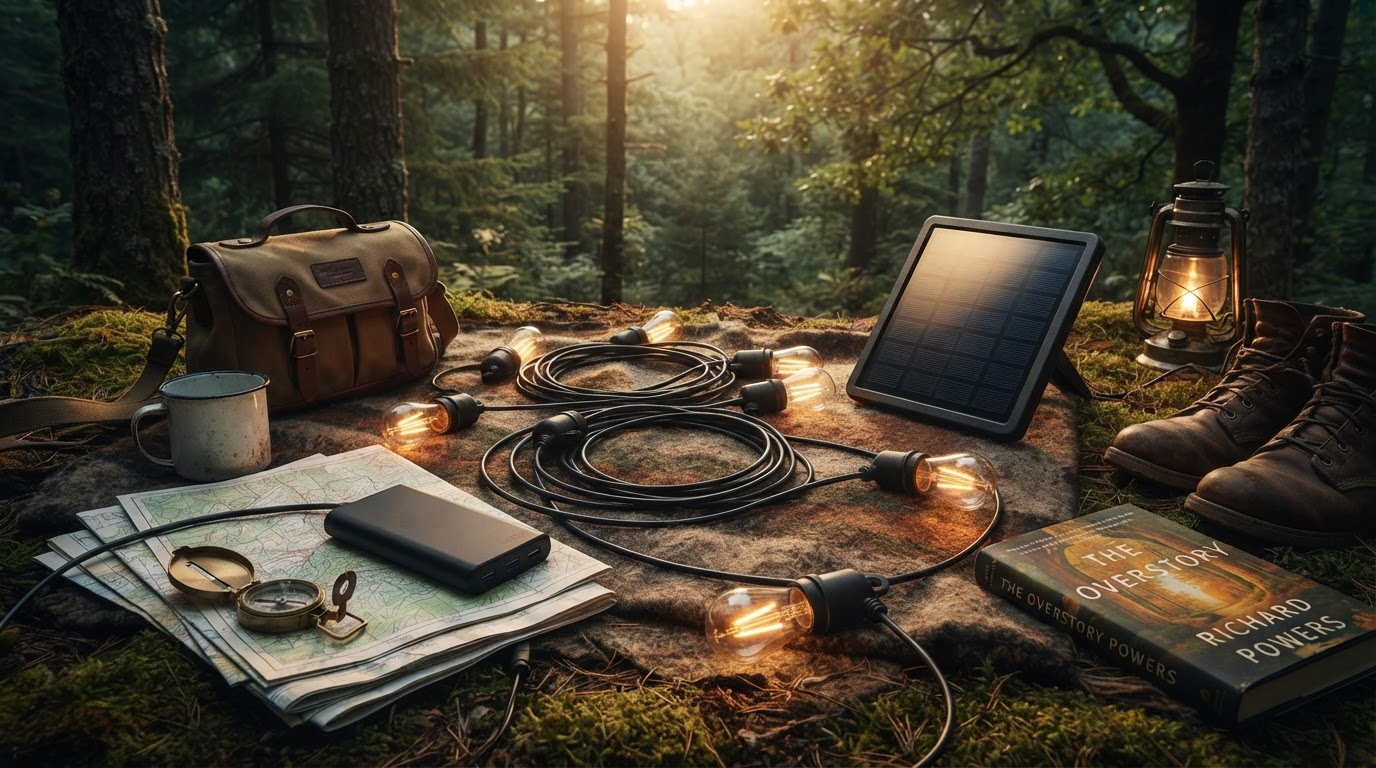
What surprised me: the Outdoor Solar String Lights I brought along didn't actually need a cloudless sky to remain functional, provided I utilized the USB-C bypass. Many modern portable systems, including the Luno Camping String Lights, now feature seven light modes and adjustable brightness to conserve energy when the battery is low. In my own kit, I found that using a lower brightness setting extended my runtime by nearly 400% during the overcast days. When the sun did peek through for an hour, I moved the detachable panel to a rock in a clearing, a tactic I also use for [heavy duty solar RV awning lights](/blog/heavy-duty-solar-rv-awning-lights) when the vehicle is parked in the shade. The specific lights I used featured a 20-bulb count, similar to the BioLite Luci models, which GearJunkie Tested and noted for their portability. By utilizing a portable power bank to 'prime' the lights via USB before heading into the deep woods, I was able to use the solar panel merely as a maintainer rather than the sole energy source. This hybrid approach is the only way to ensure your campsite stays lit when the weather turns. What I'd do differently next time is bring a longer extension cable for the solar panel itself, allowing me to reach the edge of the clearing without moving the entire light string. Even in low-sun environments, these units outperform traditional battery-ops because they don't require carrying dozens of AA batteries that eventually end up in a landfill.
A Framework for Low-Light Reliability
Here's the moment it earned its place: a sudden downpour on night four didn't short out the system because the housing was properly sealed. When selecting lights for these conditions, you have to look past the lumen count and focus on the ingress protection and charging versatility. If you are worried about limbs falling or rough handling during pack-out, opting for [shatterproof solar string lights](/blog/shatterproof-solar-string-lights) is a non-negotiable requirement for back-country use. The durability of the bulb housing matters just as much as the battery capacity when you are miles from the nearest replacement. Based on my time in the field, I recommend following this checklist before you head into a low-sun environment:
- Verify the unit has a USB-C or Micro-USB input for manual charging before departure.
- Check that the solar panel is detachable or has a lead wire of at least 10 feet to reach sunny patches.
- Select models with at least three dimming levels to stretch battery life during consecutive cloudy days.
- Ensure the bulbs are rated as shatterproof to survive being pulled through tree branches.
- Confirm the total runtime on a full charge exceeds 15 hours on the lowest setting.
Shop Outdoor Solar String Lights here.